Making Space The Seven Stones Research Project | Anno Mitchell
Article by Brendan Pointon
Fabrica’s Making Space artist residency for March 2026 was awarded to artist Anno Mitchell, who is developing an immersive audio installation exploring the 1967 Torrey Canyon shipwreck – one of Britain’s most significant environmental disasters.
March 18th, 1967: The Torrey Canyon cargo ship ran aground off the coast of Cornwall during its voyage from Kuwait to Milford Haven (Pembrokeshire), polluting nearby beaches and oceans with over 100,000 tonnes of crude oil. Regarded one of the worst environmental disasters in the UK, the spill killed thousands of seabirds and left sludge coating affected beaches in Cornwall, The Channel Islands and Britanny. This is the backdrop upon which Anno Mitchell’s newest work presents itself. Part of the ongoing project ‘generative shipwrecks’ (started in 2024), Anno uses a generative framework of ‘plausible reconstructed ship logs’ to create an immersive audio experience bringing these ship archives to life. I spoke with Anno about what this specifically meant and how these logs were put together, here’s a brief explanation:
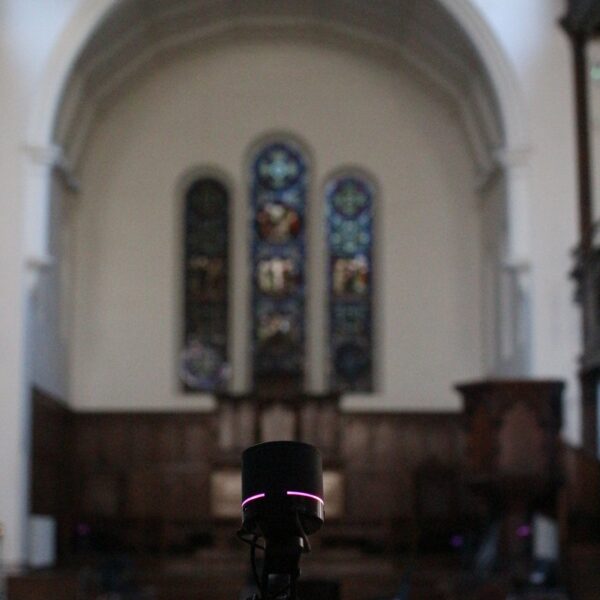
The audio logs themselves are sourced from either Anno’s own writing or readily accessible audio logs from similar cargo vessels. These are then fed into a custom program which generates new writings in the same formatting as real logs and accounts. This specific display features speakers playing these audio files around the space, using raspberry pi computers for the coding and an open-source website to upload content and convert it to audio.
When first entering Fabrica, you may have been shocked to see a mostly empty room aside from a few chairs and the speaker set-ups seen above. However, the first thing you will hear is far from empty. The room is filled with sound; in one area you may hear ship logs detailing co-ordinates, in another the battering waves of the ocean, and in another a documentary-style retelling of a disaster in the open sea. Each offers a different style of emotive response; perhaps confusion or understanding of the information being transferred, a fear or relaxation from the sounds of the wind and waves, or for some perhaps a more personal resonance to the events being recounted. Whilst the information itself is fictional, the premise from this work is far from it. Whilst I do not have a personal connection to the areas affected by the Torrey Canyon shipwreck, this installation made it easy to put myself in the shoes of those involved, or perhaps to also think about other events in which humans have impacted our environments. The work is a statement, one which opposes the destruction of our natural landscapes and ponders how events like this would have affected us on a personal and social level. From my experience, humans have a tendency to care more about social issues when they can either imagine themselves in those situations or become part of them, a method that Mitchell has expertly grasped in this audio display.
Following the public opening of this work was an artist Q&A, which was a fantastic insight into Anno’s creative process and getting an idea of the audience's response to the work. I noted down some quotes and information during this session which I hope you find as interesting as I did whilst hearing her talk to the audience live:
Anno initially described the audio logs she researched and featured in the piece as having a ‘poetic quality’, and that the work gave her ‘an enormous opportunity to work with generative forms’. In regard to working alongside generative text and audio, Mitchell described the experience as ‘like working with a studio assistant with a very low imagination’, which I think very well sums up the idea of using machine generation in the arts; it can never fully recreate or mimic the human imagination. She also explained that ‘There’s an irony of ending up with less computational forms than I'd imagined’, referring to the fact that she and John Cooper, who was responsible for the sound distribution of this exhibit, had to manually control and play audios rather than the computer do it automatically, a feature she also said will be expanded on and a great point to learn from during this residency. In the same vein, when asked if this idea of a tripod set-up with raspberry Pi computers and a speaker was always intended, she responded by saying yes and no. She always had the idea of multilayered audio but is questioning ‘How do I facilitate getting that affect’ in an affordable and easily storable manner. I’m very excited to see how the set-up changes with more audience feedback and experimentation from Mitchell herself.
So, what’s next for Anno and this project? She ended this session by stating that she is not yet done with exploring ‘shipwrecks as solid moments of human progress’, which is very exciting to hear. The experimentation with sound is also only just beginning, with so much to still learn regarding methods but also expanding the means of distribution, potentially even sending audio directly to the audiences' smartphones.
On behalf of Fabrica we extend a huge thanks to Anno Mitchell for presenting such a fascinating residency to us and our audiences, and thank her personally for giving me the time to photograph the work and ask questions regarding her creative processes.
References